Searching For Your New Property
Make a list of your essential requirements for your rented property, and a separate list of what you would ideally like when you rent your new home. Essentials would include:
-
- The minimum number and size of bedrooms for your household size.
- Location – close to work, access to bus routes/tube stations/main roads, school catchments.
- Rental budget – don’t forget to budget for bills and council tax. If you can afford to pay a little more, then you will get much better value as the competition is always fiercest for properties at the lowest prices.
- Move in date – A landlord will normally receive one month’s notice that tenants are moving out and they will try to find new tenants as quickly as possible. As a result, most rented properties are only available for a few weeks before they are let. If you look too early then you will not be able to proceed unless you are prepared to sign a tenancy agreement and pay rent several weeks in advance. If you look too late then you will have a reduced choice of properties and will have to compromise on your requirements.
- Furnishing – the majority of properties are provided part-furnished, which means the landlord will provide the basic furnishings such as beds and sofas and kitchen appliances, leaving you room to add your own bits and make the house more of your own home. The exception is student accommodation which is normally fully furnished.
- If you have young children, then you will probably want ground floor accommodation or a property with a lift. Check if there is a secure garden for your children to play and avoid properties where the front door leads directly onto a main road. Homes within the catchment of a good state school are more easily rented than finding a property to buy.
Tenancy Restrictions
Your Tenancy Agreement may limit the uses to which you can put the property. Check this for any restrictions that may be included – typically you will be prevented from running a business. for example.
Other restrictions may Include:
-
- Pets – it is common for the Landlord’s insurance policy to prevent pets being kept at the property. If you are permitted a pet, then expect to pay a premium and to pay for steam cleaning of carpets and flea de-infestation at the end of the tenancy. Animal fleas can lie dormant for weeks, so the agent may hold some of your deposit until after the new tenants have moved in.
- Smokers – HOP operates a strict NO-SMOKING policy in all of our managed properties. We do take on smokers, but you are only allowed to smoke outside the property. Smoke damages the decorative surfaces of the property and leaves an odour which puts off non-smokers. If it’s evident you have smoked then you may become liable for cleaning and re-decoration costs.
- Young children – crayon marks on walls, sticky handprints and extra wear and tear can mean that some Landlords would prefer a childless professional couple. However, if it’s a larger house with garden, then it’s always worth asking. Apartments with balconies are no-go areas for children.
- Sharers – higher levels of wear and tear and a requirement in some circumstances for the property to be licensed as a “House in Multiple Occupation (HMO)” with attendant costs for the landlord. Shared properties command a higher rent to compensate the landlord.
- Benefit recipients – the landlords’ insurers and mortgage lender may impose this restriction.
Viewings
- No matter how much you liked the property description as a potential tenant you should always view your future home before making a decision
- View the property together if you are moving in with a partner or sharing
- View properties that you are considering as quickly as possible one after the other. This will give you a better chance of being able to compare each property you view
- We accompany any prospective tenant/s on viewings – it’s a security precaution that protects you as much as anyone and it gives you an opportunity to ask questions about the property
- Take a debit card with you and a means of photo-ID, which will allow you to proceed quickly if you view something you really fall in love with
- Take a tape measure to check if your furniture will fit and a pen and paper to make notes
- If you are meeting at the property, plan your route in advance and allow enough time to get there
- Our Staff are always willing to wait if they have time, but they are usually on a tight schedule and cannot afford to wait more than 5-10 minutes
- Make sure you have the agent’s office number with you and call if you are running late
- It should take about 10-15 minutes to look around your selected property so if you are viewing several properties with different agents then plan your time
- Ask to see the Energy Performance Certificate (EPC) for the property
Dotting the I's and crossing the T's
- How much is the rent?
- What date is the property available from?
- What furniture (if any) and white goods are supplied?
- Is the landlord planning to make any changes to the property or will it be let exactly as viewed?
- Is there any parking allocated? Is there an extra charge for parking?
- Are there any restrictions on the type of tenant?
- How much is the deposit if required or deposit alternative?
Be clear with the agent on the terms proposed. For example, you may have offered to pay the full asking rent, providing that the landlord will agree to your tenancy starting on the 1st June for 12 months and will supply a washing machine. The agent will need to check the terms proposed with the landlord and get their agreement.
Application Procedure
-
- APPLICATION FORM – Please fill out ALL sections of the application form, if it doesn’t apply to you, put N/A – This will be sent via our referencing partner
- RESERVATION (HOLDING FEE) – Bank details are on the application form, this payment is then applied to your rental upon move in
- REFERENCE CHEKCS VIA REFERENCING PARTNER – We use a 3rd party company to carry out all the reference checks, you will receive an email on how to upload all your documents
- CREDIT HISTORY – This will tell us if you have any Bad Credit History, CCJ’s or Bankruptcy. If you do, we will need a UK based Guarantor to act on the Tenancy
- PROOF OF ID – Copy of your Passport or Driving Licence, we will need to see this in person before the move in date
- OPEN BANKING – We require all applicants to process the referencing via open banking by our 3rd party referencing partner
- PREVIOUS LANDLORD – We require written references from your previous landlord
- GUARANTOR – We will require a Guarantor if you are a student, or you are not in permanent Full Time employment. If a Guarantor is required, we will need the Guarantor to fill out an application form and provide wage slips or mortgage statement, so please ask them first.
You may be asked by the referencing partner to get in touch with your employer if they are slow in providing a reference.
If you are sharing, the tenancy cannot be approved until each and every sharer has successfully applied. Legally, you will each be liable for the whole of the rent and not just “your own share” however the credit reference company will assess your individual ability to pay the rent on a part share basis.
Assuming your application is successful the agent will set a date for when the tenancy agreement will be sent out digitally. All of the tenants will need to attend the appointment or will need to sign the tenancy agreement in advance. Any Guarantor(s) will also need to sign in advance.
You will be asked to ensure you have “cleared funds” meaning cash or a banker’s draft (the bank will charge you a small fee to provide this) or possibly a debit card payment. You will not be able to pay by cheque or credit card. We use a payment system called PayProp, you will need to make the full payment into this and if you have opted for the deposit replacement scheme you will receive the bank details for this payment.
The tenancy is not legally binding until it has been signed. If the property has been advertised through several agents simultaneously it is important that the agent you are using communicates with the landlord to ensure that only your application is proceeding. If the landlord changes his mind or lets through another agent then unfortunately there is very little your agent you can do to. However, you should be refunded your application fees and the agent should make every effort to find you suitable alternative accommodation.
Guarantor
Agents normally use credit referencing companies to carry out checks and provide a recommendation on your suitability. If you have no adverse credit history but are financially weak for the rental amount then you may be able to arrange a Guarantor.
A Guarantor is someone who agrees to abide by all of the terms of tenancy agreement, including the payment of rent, but has no right to live at the property. Your Guarantor will also need to be credit checked and there is normally an extra fee to pay for this.
Tenancy Information & Tenant Fees Schedule
When you agree to rent a property you will be not be expected to pay any fees to LV PROPERTY from the 1st June 2019.
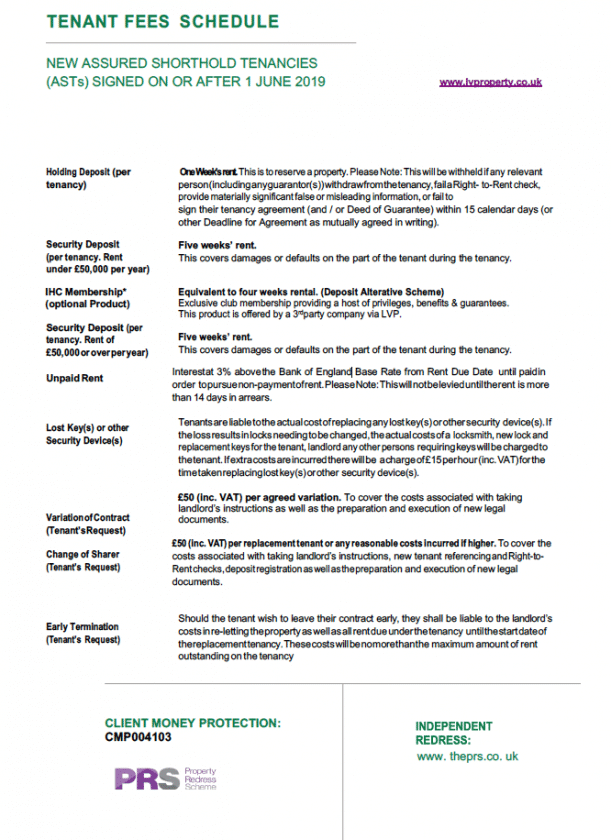
Before you reserve the property of your choice you will be offered either a DPS Deposit Protection Scheme or Deposit Alternative Scheme the alternative scheme will offer more flexibility and cost savings over time.
Inventory & Schedule Of Condition
Find out who is managing your property and make sure you have been given all their contact details. That way, if something goes wrong on the property, you’ll know who to get in touch with.
Look after the property as if it were your own. This reduces the likelihood of disputes over damage when the tenancy comes to an end.
Remember that you should arrange insurance cover for your furnishings and personal property – the landlord is not responsible for insuring these items.
Deposit Alternative Option
We know tenants currently face a lot of financial pressures, from raising the initial deposit and costs of moving, to saving up to buy their first home. That’s why we offer a No Deposit Option for renters – Click the link to find out more (Deposit Alternative Option)
Moving out
You will be provided with a ‘Schedule of Condition and Inventory’ relating to your property. Tenants need to read this document thoroughly and notify the agent of any discrepancies as quickly as possible after the start of your tenancy. Most agents will set a time limit of around seven days, after which it’s assumed you are accepting the property in the condition described. The agent or Inventory provider may wish to revisit the property to verify the discrepancies.
How to rent – the checklist for renting in England
This guide is for tenants and landlords in the private rented sector to help them understand their rights and responsibilities. It provides a checklist and more detailed information on each stage of the process, including:
- what to look out for before renting
- living in a rented home
- what happens at the end of a tenancy
- what to do if things go wrong
Click Here for more information